01 · Results
The non-invasive Muse cell magic that's the new Hollywood buzz.
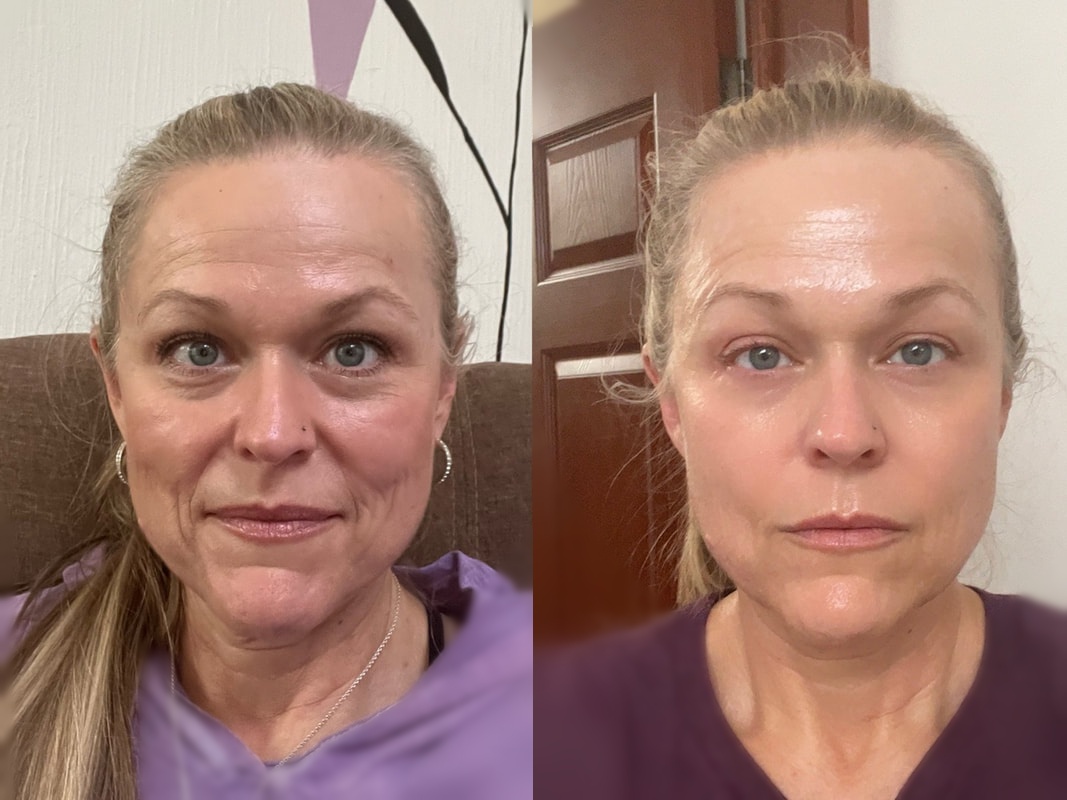
One session in, and it already shows:
- Smoother, tighter texture
- Firmer skin, tighter pores
- Fewer fine lines, less crepe
- Brighter, more even tone
- Less redness, less sun damage, fewer acne scars
- That “I-don’t-need-makeup” glow
Before
After — 3 Treatments
Visible within days. Full collagen effects by week 6. Most patients build to a series of 2–4 sessions, a month apart — then just maintain it.
02 · Beyond The Face
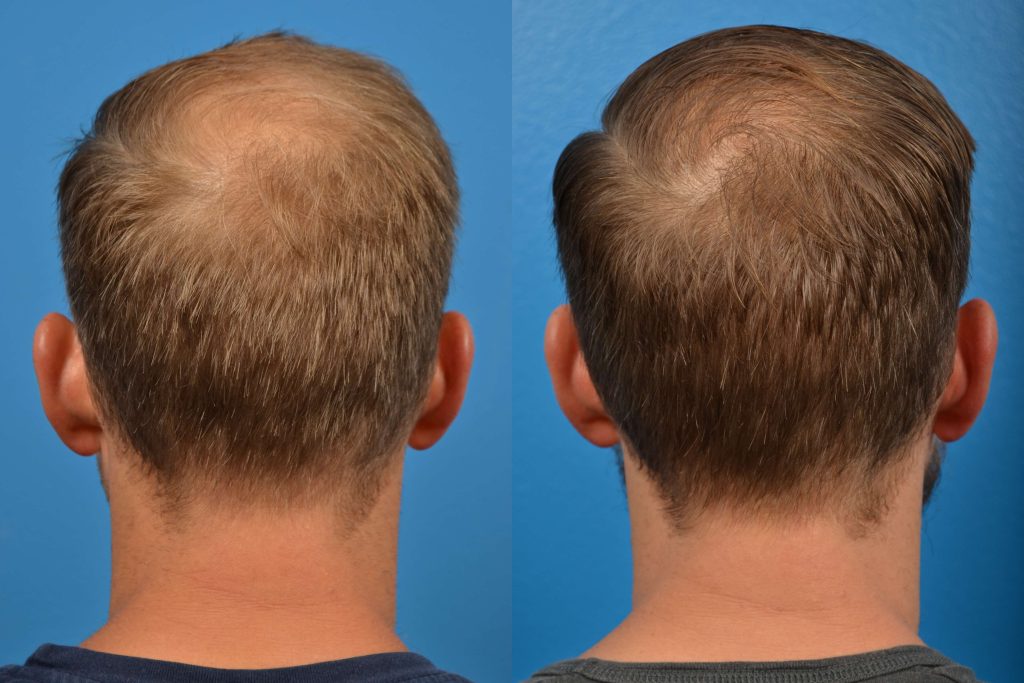
Also used for scalp & hair.
The same lyophilized MuseExosomes kit is also used off the face — applied to the scalp immediately after microneedling, the same uptake-window mechanism described above, this time directed at hair follicles and the dermal papilla rather than facial skin.
The Application
Applied immediately after scalp microneedling — reconstituted chairside and worked into the treated area while uptake is greatest, the same protocol used on the face.
The Target
Delivery is directed at hair follicles and the dermal papilla — the structures involved in the hair growth cycle — rather than the epidermis.
Suggested series: 4–6 sessions at monthly intervals, timed to your scalp microneedling schedule.
03 · Provenance & Mechanism
What Muse cells are, precisely.
Muse cells — multilineage-differentiating stress-enduring cells — are a defined subpopulation of mesenchymal cells. They're isolated by sorting on SSEA-3, a pluripotent-associated surface marker, and represent roughly 1% of cultured MSCs sourced from donated human umbilical cord tissue.
What Are MuseExosomes®?
MuseExosomes are not the Muse cells themselves — they're the exosomes those cells secrete: tiny lipid-bound vesicles carrying proteins, growth factors, and signaling molecules. They're collected, purified, and lyophilized from donated umbilical cord Muse cells, so the kit contains no live or intact cells — just the cell-free signaling payload, applied topically in the window when skin's uptake is greatest.
The Advantages
- A defined, single-source population — not a pooled or unspecified vesicle blend
- Selected by a specific surface marker (SSEA-3), not a broad, mixed harvest
- Naturally occurring — no genetic modification or immortalized cell lines
- Lyophilized for stability — no cold chain required, reconstituted immediately before use
- Paired with a functional diluent (copper-peptide + hyaluronic acid), not inert saline
SourceHuman donated umbilical cord, Muse-derived
Selection markerSSEA-3
FormatLyophilized, cold-chain-free
DiluentHA + copper-peptide complex
04 · The System
A single kit. Five treatments.
Nothing is pre-mixed, because a reconstituted biological preparation has a materially shorter usable life than a lyophilized one. Reconstitute chairside or at home, immediately before use.
Component A
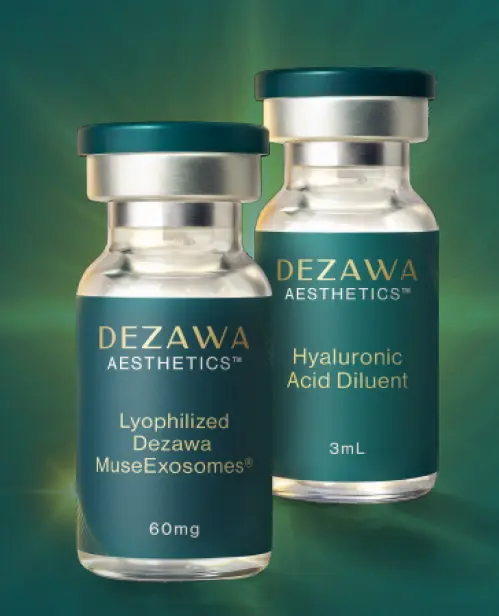
Lyophilized Dezawa MuseExosomes®
Presentation5 × vials
Fill weight60mg per vial
SourceHuman donated umbilical cord, Muse-derived
FormFreeze-dried cake
Trehalose is the excipient with published support as an exosome lyoprotectant, preserving vesicle integrity through the freeze-drying cycle.
Component B
Hyaluronic Acid Diluent
Presentation5 × vials
Volume3mL per vial
GHK-Cu3.0%
Palmitoyl Tetrapeptide-7 / Acetyl Hexapeptide-80.01% / 0.05%
A finished formulation, not inert saline — reconstitutes Component A and delivers the peptide complex in one application step.
05 · Application
Paired by modality.
Results are best when application lands inside the uptake window — the interval right after a procedure has transiently increased skin permeability.
RF Microneedling / Morpheus8
Our preferred pairing. Apply immediately post-treatment; leave 10–15 minutes; avoid washing the area for six hours.
Mechanical Microneedling
Apply immediately after the final pass. Unoccluded channels reseal within approximately two hours.
Fractional CO₂ / Ablative
Apply immediately post-pass. Published protocols used three sessions at three-week intervals.
Bring Your Own Kit
Purchase your kit individually and bring it to your microneedling or Morpheus8 appointment — your provider reconstitutes and applies it chairside, timed to the same uptake window.
Suggested series: 3 sessions at 3–4 week intervals for skin rejuvenation, timed to your device protocol, with periodic maintenance.
Start with a conversation.
Tell us about your skin goals and whatever procedure you're already considering — we'll map where MuseExosomes fits into it.
These statements have not been evaluated by the FDA. There are currently no FDA-approved exosome products. This product is not intended to diagnose, treat, cure, or prevent any disease, and is supplied for topical use only — not for injection, infusion, or any parenteral route. This kit is available for individual purchase; application should be performed by a licensed provider during your microneedling or Morpheus8 appointment. Individual results vary and are not guaranteed. Selected references: Kuroda Y et al., PNAS 2010;107(19):8639–43 · Systematic review of exosomes in aesthetic medicine, Aesthetic Surgery Journal 2026;46(Suppl 1):S13 · Charoenviriyakul C et al., Int J Pharm 2018.